Description:
Expert SEMpdx panel featuring a Q&A discussion on “What’s New for 2019 in Digital Marketing.“

![Mike Rosenberg, Pseudo Host [Podcast]](https://www.veracityagency.com/wp-content/uploads/MIke-Rosenberg-Pseudo-Host-of-PR-Talk-Podcast_800.jpg)
In this episode, I sit down to talk with our occasional host Mike Rosenberg about his background, role at Veracity and what he does for fun. Soon, Mike will reverse our roles and interview me because you will be hearing a lot more from us in future episodes. We thought maybe a little background would be good.
We are trying something new for this write-up by posting the episode transcript.
Amy: Hello, Mike Rosenberg.
Mike: Hi, Amy.
Amy: Hi, podcast listeners. We kind of figured that since we are going to be podcasting every week, you might kind of want to know who we are. Maybe you don’t want to know. Maybe if you knew who-
Mike: Just keep it a secret?
Amy: Well, maybe if you knew who we really were, you wouldn’t want to listen.
Mike: Don’t Google Amy Rosenberg. Actually, don’t Google Amy Winehouse.
Amy: Ooh, yeah, don’t Google Amy Winehouse and wonder why not to Google Amy Weinhouse. I’ll just say Amy Winehouse spells her name incorrectly.
Mike: There you go. We’ll discover that one maybe on your episode.
Amy: I’m the real Amy Weinhouse.
Mike: There you go.
Amy: Okay, yeah, so again, it’s not the Amy show. You might think it is.
Mike: It is sometimes.
Amy: Well, most of the time. But today, we’re going to learn about Mike.
Mike: Why?
Amy: Well, I don’t know why, but we just want … Maybe once we hear from Mike, we will understand why we want to know who he is.
Mike: Well, I’ve done a couple of episodes. It’s been a while, though, for sure.
Amy: Well, and you’re going to be doing episodes with me-
Mike: Moving forward, right? So we’re going to go every week now, instead of every other week, and we’re doing this because we’re adding a new kind of content. Or doing our content more that’s just kind of us educational, right? In addition to interviewing others in the media world or in the marketing world.
Amy: Yeah, so we just thought this would be a fun chance for you to get to know Mike. So what did you do … I don’t know, do we want to talk about what you do now first, and then talk about where you came from?
Mike: Let’s do it the other way around. We’ll evolve into what I am now.
Amy: Okay, so where did you go to college?
Mike: Went to the University of Oregon. Go Ducks. After graduating … I actually was the in the first class … It actually wasn’t a major yet, but my claim to fame is one of the first folks to go through sports marketing. It was long enough ago that sports marketing, which U of O is well known for their sports marketing program and their sports marketing degree.
Mike: I have a business management degree with an emphasis in sports marketing because when I was a junior, there was this new program called sports marketing, and they said you learn business administration with kind of a sports twist to it. So in your law class, it has to do with sponsorship contracts and law for sports and that sort of thing. And I thought, well, that sounds pretty cool. I like sports. I’m going to follow that. So I got that emphasis, which … And then after college, I actually did what my degree says and went into sports marketing.
Amy: Wow, that’s amazing.
Mike: Right? One of the few.
Amy: Right. And I remember we always … Because I have known you for quite a while. We actually met at U of O.
Mike: Right.
Amy: And I’m not going to tell you how, but we did meet. Maybe we could create a poll to see how do you think Amy and Mike met at U of O. Pretty typical, I’ll just say that. But I remember when you got your first job out of college, it was pretty hilarious because you used to use the excuse that you were watching sports for work.
Mike: Oh, it wasn’t an excuse. It was reality. I had to watch the game.
Amy: That’s too bad, right?
Mike: And I had to read the sports section. Now, did I have to only read the sports section? Probably not, but it was a good excuse.
Amy: Yeah, so what was your job?
Mike: I was with the Oregon Sports Authority. It was actually the Portland Oregon Sports Authority at the time, and we were … It is a sports commission, which means our overall job and mission was to bring events and franchises to Oregon for quality of life, economic impact, that sort of stuff. It was a private nonprofit, but oftentimes it’s a public entity that’s supported by state, federal, or county government.
Amy: Okay, and so how long were you there?
Mike: I would have to look at my LinkedIn to know for sure, but I know I was … Well, it was probably about four years, with a quick thought.
Amy: Oh, that’s a while.
Mike: Maybe three or four years, yeah. So I was there for a while. I ended up being the marketing director, and as I mentioned, one of the things that we did was we tried to bring in events. We brought in events for economic impact and quality of life. One of the big events, the biggest event at the time and maybe still is, that we brought in was the US Figure Skating Championships. So part of my job was to go out and pitch and create bids for these major events that move across from city to city, and the Figure Skating Championships was one of those that we got during my tenure at the Oregon Sports Authority.
Amy: Right, and then you went on to manage that event.
Mike: Exactly. That’s why I bring it up. I then transitioned … They were looking for someone to run it locally. I raised my hand, they selected me, and then so I did that for … I think the total job was about three or four years, so a couple of years to get ready for it, and then the event, which was in 2005, and then a couple of months afterward to wrap everything up.
Amy: Yeah, that was kind of a big deal for Oregon because that’s what people competed in before they went to the Olympics, right?
Mike: Exactly, yeah. In Olympic years, it was the Olympic qualifier. Like I said, it was and maybe still is the biggest one-time sports event that Portland has hosted. We had the Moda Center, which then was the Rose Garden, and the Coliseum, and a couple of other ice rinks around town full for basically a week. It was live on TV. In fact, my biggest memory from that is … which is interesting we’re talking about this today, because there’s a snowstorm, “snowstorm” in Portland today.
Amy: As I roll my eyes.
Mike: Yeah, it’s not much of a storm, but school is closed and all that stuff. Well, there was a real snowstorm during the US Figure Skating Championships, and I remember contemplating whether we were going to postpone or call the event, because there was ice, and would people be able to get there?
Mike: And I remember talking with the folks on … with the TV station, which I believe was ABC, and basically they said, “If the skaters can get here, we have to go live, because yes, there’s thousands of people who are coming to watch it live in Portland, but there’s millions of people who are watching it on TV, and this is scheduled out. We’ve sold millions of dollars’ worth of commercials,” and all that sort of stuff. So yeah, it was a big deal. It was a fun event, and I learned a ton doing it.
Amy: Well, it’s kind of nice to have the news tell you how to make a decision for once.
Mike: Well, yeah, it wasn’t really the news. It was the production folks. It was the sports production side of it, but yeah, it’s the media.
Amy: And then from there, you worked on your own for a couple of years, kind of trying to sell sponsorships for events like that, right? Is that what you would say that was?
Mike: Exactly. Yeah, I was consulting for anything in sports that was revenue generation, so a lot of that’s sponsorship, also consulting on ticket sales and those sort of things, merchandise, that kind of stuff. But it was in the sports world, basically things that drove revenue, were my clients, so mostly events.
Amy: Okay, and then you moved on to EngineWorks, which was a digital marketing agency, and why did you do that?
Mike: Well, really, the gist of it was that I got frustrated in sports. So for someone who took sports marketing and worked in the sports world to have an excuse to watch sports and be involved in it, and I’ve always played sports and been a big fan, I got frustrated on the marketing side, and it was mostly because it seemed like I was banging my head against a wall every time we tried to do something new.
Mike: For example, on the sponsorship side, we’d try to come up with maybe a different thing to sell or a different way of measuring it. One of the things that got me was in car-racing stuff, and how we measured the value of a sponsorship, even locally, had to do oftentimes with how many milliseconds … This is car-racing, so things are moving fast. Someone’s banner, if it got a tiny, little millisecond on TV, how many of those was a big thing that went into determining the value of a sponsorship. And I just kept running into asking, “Why are we doing it like this?” And the answer was always, “We’ve always done it this way.” It was like, “Well, why don’t we do something different? Why don’t we try something different?” “No, no, no, we’ve always done it this way.”
Mike: So I actually was having lunch with a friend of mine, Kent Schnepp. He was talking about EngineWorks, this startup, basically a digital marketing agency that he was starting or had actually just started, and wondering if it was something that I would get involved with. And for me, it made a lot of sense because we couldn’t really ask how to do something, because we were basically in a new industry at the time, right? So it was like, “Well, how do we do this? I don’t know, we’re going to have to figure it out.” So that was really cool.
Amy: Oh, cool, so it totally flipped that old idea on its head.
Mike: Exactly, exactly. And I think that, in regards to sports … I don’t want to bash the sports marketing world, because I think they’ve caught up a lot, and there are lots of organizations … In fact, in our hometown, Portland Trail Blazers are one of the leaders in digital marketing and social media and have really taken a step to embrace it, but it did take a while.
Amy: Okay, so tell me what it was like working at EngineWorks/Ethology, because it then turned into Ethology, so we’ll just call that the same job.
Mike: Right, so that was where I learned digital marketing. We were, first and foremost, a search marketing agency, so what that means is SEO and paid search, so AdWords. We were specialists in those two areas in the beginning. We added social media as kind of part of our search offering a couple years in as that grew as an industry. But for me, it was great because I learned that industry, right?
Mike: I joined SEMpdx, I then got on the board, became president, and would go to all of their educational events. I was in charge of client acquisition, so my job was to help the company grow its client base, so the actual doing of SEO, of paid search, I didn’t actually ever do, right? Although, as I was selling things … and this is I think 100% true, especially back then … I knew SEO better than 90% of the people that we competed against, the people who were actually doing it, because there was a lot of-
Amy: You mean the other salespeople?
Mike: No, the other actual doers, because that industry-
Amy: How do you know that?
Mike: Just from talking with other folks in the industry and reading things at the time. There was a lot of folks that were just kind of selling absolutely nothing. But anyway, that was in the past. I’m sure there’s still a bunch of folks who are out there doing that now, but I don’t think they last very long.
Amy: But not necessarily. So this is going to be more about your resume and your background, but just in general, digital marketing does have a bad reputation.
Mike: It does, and it earned it in the beginning, and I’m sure there’s still a ton of folks … I mean, I get calls from “Google” still, and it’s obviously not Google calling me. Well, it’s obvious to me, but the reason … but it’s not obvious to a lot of the people answering the phone, which is why they’re doing it.
Amy: So it’s deceitful.
Mike: So it’s deceitful, yeah.
Amy: And then you’re saying a lot of these people don’t know what they’re doing.
Mike: Correct, they definitely didn’t in the past. I think that’s … I mean, it’s caught up a little bit.
Amy: Why do you think you kind of knew what you were doing? Was it your involvement with SEMpdx, or was it the group you were working with?
Mike: It was both. We were selling a real service, and I always think to be able to sell something, you have to understand it. You’re not just selling … I was going to say “air,” but in real estate, air is an actual thing that you do sell.
Amy: I have sold air, but we’ll talk about that next week.
Mike: Exactly, exactly. So that’s where I learned the industry. I learned the industry at EngineWorks. Our goal that was stated to … that everybody knew, from owners to management to new employees that our goal with that was for some sort of event, whether that’s to be acquired or go public or something like that, so that was a stated goal, and we did that. We were acquired, so that’s why EngineWorks became Ethology.
Amy: Oh, okay. So then now, kind of switching gears into what you’re doing today, which is kind of more about our company, I want to ask in the sense of, like … Well, I don’t … Because I don’t want to get too into the background of why … of our company, I guess. I’m curious, though, why you did switch to work for our company, to work … Or not for our company, but with me. But I don’t know if we want to get into the whole story of that. And if not, we could just talk about, what do you see as the similarities and differences from working at Ethology versus Veracity?
Mike: Sure. Well, at Ethology … Well, at EngineWorks, before we were acquired, I was a part of the leadership team, and now I continue to be part of the leadership team at Veracity, so those things are the same. We go after different types of clients. I would say that, similarity-wise, we would be more similar to, again, Ethology because it was kind of more full-service than EngineWorks was, being specifically a search firm, that Veracity is, although we certainly have very specific things that we do, right? So that’s similar, as well.
Mike: Differences? Size. That organization was a lot bigger, employee-wise. We had some very specific industries that we went after. We were big in the hotel and hospitality space, which we continue to do some work in that space at Veracity, as well, but we’re not quite as direct on who we work with. So those are kind of some of the similarities and differences.
Amy: Okay. I’m giving you a fun-
Mike: I didn’t work with my wife.
Amy: Who, your wife would say, “Please, no hotels.” No, just kidding.
Mike: Yeah, right?
Amy: Do we want a hotel? Sure. I don’t know if we’re running after them. But okay, so what do you do today at Veracity?
Mike: Sort of the transition story into Veracity was you, Amy, was doing PR, kind of started Veracity or … It’s actually kind of … I don’t know if this interests anybody else, but I find it interesting that, as we talked about, my consulting company, it was called Rosenberg Marketing, right? And then when you kind of … Rosenberg went to bed, took a nap when I joined EngineWorks, and then you kind of woke it up and changed it into PR consulting.
Amy: Yeah. Well, I mean, you already had the LLC and all that paperwork figured out, so I just-
Mike: Yeah, exactly. The technicality stuff was done.
Amy: So you did all the work I didn’t want to do.
Mike: Right, exactly.
Amy: Thank you.
Mike: Yeah, no problem. So you were kind of running what eventually became Veracity, which turned into Veracity as a PR firm, right? So what I did was I brought in the digital side of that, so from my experience at EngineWorks and Ethology, I brought that to the table for us so that we were more well-rounded and bringing us into modern-day marketing a little bit more.
Amy: Well, yeah, but you did … You’re not really giving yourself much credit, because … I don’t want to get too into the company history, but when I was doing PR, I really was just a freelancer.
Mike: Right.
Amy: So then you were able to come and help bring it up to the next level of not being a freelancer, being an actual company. And then we changed the name.
Mike: Changed the name. We got an office, changed the name, hired people, all that sort of stuff.
Amy: So then what do you do now? Did you already say that? Since we are married, you might notice a theme: I don’t listen to him. It is what it is. Just get used to it.
Mike: So now I continue to be basically in charge of the digital side of our business, as well as I do operations. Just as you mentioned that I created the-
Amy: All the boring things.
Mike: Yes, all the boring things.
Amy: Thank you.
Mike: Payroll, taxes, setting up systems, a little bit of sales when we actually ever do any.
Amy: Meaning we don’t reach out, but people reach us.
Mike: Yeah.
Amy: Sorry if that was you that we hung up on the other day. So if you want us to work on your account, we might hang up on you, not knowing that it was a new business call.
Mike: Not on purpose. Yeah.
Amy: Anyway, somebody called when we were in the office on a conference call with a client, but of course we’re basically millennials, even though we’re not. Pretend that we’re millennials. We’re on our cellphones all the time, so if someone calls our landline-
Mike: Right, or on speaker.
Amy: … I’m just going to hang up on them. I’m going to pick it up and hang it up. I’m a millennial, but I’m 41. Anyway, so what … You have a lot of extracurricular activities. Are you trying to get credit-
Mike: I’m trying to get into college.
Amy: No, yeah, exactly. Are you trying to get into some grad school? What the heck?
Mike: I’m not doing that much anymore. I just have filled out my LinkedIn profile, which you’re looking at.
Amy: Okay, but are you supposed to have all this on here as a LinkedIn expert?
Mike: What do you mean?
Amy: Well, I don’t know, I mean, this gala marketing committee co-chair for OMSI.
Mike: What, back in 2011? Yeah, sure. Why not? I don’t know, LinkedIn keeps telling me that my profile is good.
Amy: Okay, so you’re still involved with SEMpdx.
Mike: I am. Right, yeah, so I was … I think I was on the board for either eight to ten years, because we had two-year stints, and mine ended being past president, so two years of that, two years of president, and some years before that. And as I mentioned before, that was one of the big education pieces for me.
Amy: And then what do you do … It says you’re a board member for B’nai B’rith Camp. What is B’nai B’rith Camp?
Mike: So BB Camp is a Jewish summer overnight camp at the coast, and I’m on the board.
Amy: And why are you on the board?
Mike: Well, long story short, my kids love it, my father was involved and has been involved for a long time, there’s … I end up at that camp once a week for a weekend at the end of the summer-
Amy: Thank God.
Mike: … as kind of a go do sports and eat too much and hang out.
Amy: You mean you go as a camper?
Mike: Yeah.
Amy: Like, with other kids or …?
Mike: No, with other adults.
Amy: I’m just kidding. And is it called Men’s Camp?
Mike: It is, yeah.
Amy: Is it just for Jewish guys?
Mike: It’s mostly, but not exclusively, no. And the whole purpose of it, and the whole purpose of me being on the board, is to raise money for kids who can’t afford to go to camp, right? I’ve heard so many stories from people whose lives have been positively impacted because they were able to go. Some of them, they could go because their families could afford to send them, and some of them wouldn’t have been able to go.
Amy: And they would have been sitting at home, all alone by themselves for the summer.
Mike: Exactly.
Amy: Because their parents were working.
Mike: Yeah, exactly.
Amy: So this got them out into nature and with a community and-
Mike: Yeah, a lot of them, it gave them a place where they could be themselves more so than anywhere else that they felt comfortable. And like I said, I’ve heard quite a few different stories of people like that.
Amy: Yeah. So then you’re still involved with that today.
Mike: I’m still involved with that. I’m on the board there. I’m also a member of the Rotary Club of Portland, and my-
Amy: And that keeps you really busy.
Mike: Well, we have a meeting or a lunch once a week.
Amy: Which I love.
Mike: Right, you love that. And I guess … and I think I’ve said this, whether it’s on LinkedIn or maybe it was another … oh, it was another podcast that I was a guest on. If anyone in the Portland area, or if you happen to be in Portland on Tuesday and want to come to lunch with me, I kind of put out there an open invitation, I’ll take you to lunch on Tuesday at the Sentinel downtown, as a guest of mine for Rotary.
Amy: Well, actually, if anyone wants to go, next week it’s the Oregonian talking-
Mike: Right, yeah, the history of the Oregonian.
Amy: … about the past, present, and the future. And it’s Therese Bottomly, who is the-
Mike: Editor?
Amy: Editor or something like that.
Mike: Yeah.
Amy: And I cannot go, unfortunately. I have a client meeting that came up last minute, but I was definitely planning on going, so if one of you guys want to go, let Mike know.
Mike: Right. Yeah, and if you follow anything that we do, if you follow it closely, you’ll also see that I’m the chair of the Oregon Ethics in Business Awards, which is an event hosted by … which means we do all of the work … the Rotary Club of Portland, and presented by KGW, where we honor businesses and nonprofits every year for ethical business practices. So we have a nomination process, which we’re in the middle of. Or the nomination process is over, but a selection process, and then we’ll have a big gala dinner to announce the recipients and celebrate what they’re doing in their organizations and businesses.
Amy: So then, now that we’re done-
Mike: And that’s the part that keeps me kind of busy.
Amy: Yeah. Well, right now, but once that’s over, it won’t be as bad.
Mike: Right, right.
Amy: But now that we’re done with your LinkedIn profile, is there anything you can tell us in a couple of minutes about what you like to do in your free time?
Mike: Ooh. Well, my favorite thing right now is skiing, so I was a-
Amy: I knew you were going to say that.
Mike: Yeah, I was a big skier when I was a kid and through high school and that sort of stuff. And pre-kids, went a fair amount, but once kids came into the equation, for the most part, it ended. And then this year, both of my kids got into snowboarding, and so once I had that commitment from them, I scheduled them up for lessons and to go up to the mountain, and that’s what I really like.
Amy: Yeah, but you exercise like every day, which actually makes me annoyed because I don’t.
Mike: Well …
Amy: But it’s a good … you’re a good role model.
Mike: Yeah.
Amy: So what all do you do for your other exercise, besides skiing?
Mike: I play basketball a couple times a week. I also love coaching … Assistant coach … I don’t want the responsibility of a head coach, but assistant coach for both my kids’ teams, which is fun.
Amy: Well, you’re doing both kids’, so you can’t do head coach.
Mike: Right, and I don’t have time. Even if it was one kid, I don’t think I’d have time for that, because evening meetings during practice, when you’re an assistant coach, you can say, “Hey, sorry, Coach. I can’t make it.” When you’re the head coach, you can’t really do that. And then I just started running because I joined a neighborhood team for Hood to Coast, so if any of you listeners know what Hood to Coast is, you probably think I’m crazy.
Amy: Well, we already knew that. So yeah, a lot of exercise and family stuff, it sounds like.
Mike: The free time that I have, that’s where it goes, for sure.
Amy: And then podcasting on the side.
Mike: Podcasting on the side. I like that. With a dish of podcast on the side

Throughout Oregon and Southwest Washington, PRSA provides members with networking, mentorship, skill building and professional development opportunities – whether you are a new professional fresh out of college or a skilled expert with 20 years in the industry. Check out PRSAoregon.org for more information on how membership can help you grow and connect.
In such a fast-paced, multi-faceted work environment, it can be tough to stay on top of everything. monday is the collaboration tool trusted by businesses of all kinds to help cut down the clutter and streamline productivity. Learn more at monday.com and signup for a free trial. You’ll see in no time why so many teams around the world are choosing monday for their project management needs.
PR Talk listeners can use the coupon code BetterExecute for a 15% discount.
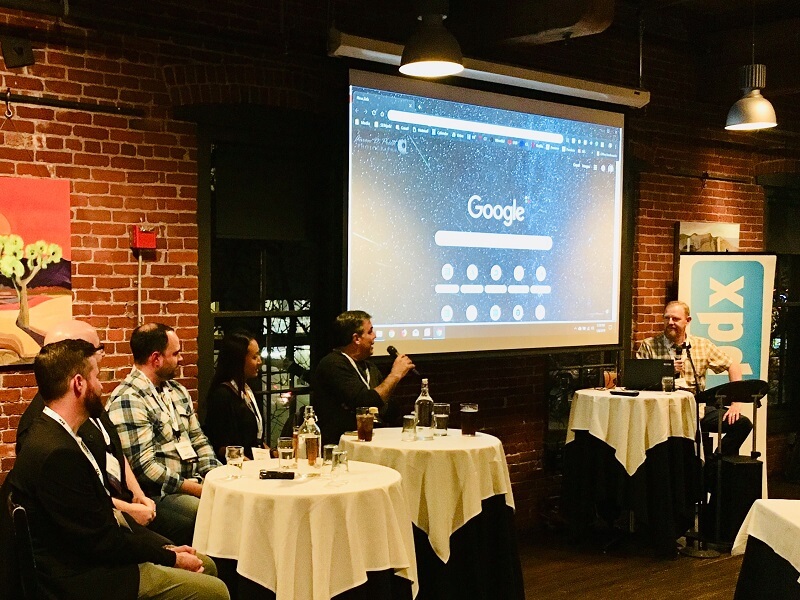
I recently attended SEMpdx’s monthly educational event featuring a panel of digital marketing experts. They were tasked with providing insight into what is new (or will be new) in digital marketing for 2019.
As we have done previously when we think a topic may fit our PR Talk audience, we record it.
If you can’t tell, we are focusing PR Talk on digital marketing with the Engage Conference coming up on March 7th & 8th, where Amy will be speaking about Digital PR.
Expert SEMpdx panel featuring a Q&A discussion on “What’s New for 2019 in Digital Marketing.“
Founder & CEO, Avenue

Founder & Lead SEO, Webfor
Founder, Search Commander, Inc.
Assoc Director Demand Gen, Obility

VP of Digital, Vacasa
Matthew Brown
Consultant, SEMpdx Advisory Board Member
What changed in 2018? What did 2018 teach you for 2019?
How did Google’s changes in 2018 effect SEO and Paid Search for B2B industries?
Managing a big enterprise client, did you have an advantage in 2018?
Do you need more content to perform well in specific industries (recipes given as an example)?
As agency owners, how would you change the mix of what you offer your clients in 2019?
What is quality content?
How will the technical elements of SEO matter in 2019?
In regards to schema mark-up, should you mark-up all that you can or just specific things?
Should you delete old content (blog posts) on your site?
What Google My Business (GMB) and local SEO stuff should we know about?
What is your prediction for voice search and the written word in regards to voice search?
How will website privacy impact 2019?
What will Bing do in 2019?
Share something new and improved for 2019 that you are excited about (tools, blogs, etc.)?
Do you have insights on email marketing and SEO podcasts to listen to?
Throughout Oregon and Southwest Washington, PRSA provides members with networking, mentorship, skill building and professional development opportunities – whether you are a new professional fresh out of college or a skilled expert with 20 years in the industry. Check out PRSAoregon.org for more information on how membership can help you grow and connect.
In such a fast-paced, multi-faceted work environment, it can be tough to stay on top of everything. monday is the collaboration tool trusted by businesses of all kinds to help cut down the clutter and streamline productivity. Learn more at monday.com and signup for a free trial. You’ll see in no time why so many teams around the world are choosing monday for their project management needs.
PR Talk listeners can use the coupon code BetterExecute for a 15% discount.
![How To Operate Like a Newsroom [Minicast]](https://www.veracityagency.com/wp-content/uploads/yolanda-sun-44470-unsplash.jpg)
First, a caveat, if you can bring a professional photographer, do it! If you are good at taking photos and videos, skip to the parts about how to submit them or what makes for a good photo opp.
They say a picture is worth a thousand words. Could we be focusing on the wrong thing with all this text? Would you rather have a big picture on the cover/homepage of the New York Times or an article inside? We want both, of course, but the photo is what gets more attention from our audience!
If you are as uncomfortable as Amy, a self-admitted terrible photographer, with taking photos and videos, don’t be. We have had photos and even iPhone videos, taken by this terrible photographer, run on TV.
Of course, you still would rather have the media come (you are more likely to get the story to run), but what if they don’t? You have to fill the role of the reporter even more. Let’s call it HARO, Help a Reporter Out…maybe that’s already taken.
If the news won’t come, serve as an extension of their newsroom by:
Taking photos on your smartphone is easy. Taking really good photos is not. Follow a few basic tips and you will be getting pictures that are good enough to share with the media. Here is a list of what to look out for:
“Take the damn photo!”
Other general (non-technical tips):
Tips for taking videos with a smartphone are basically the same as photos, with a few added suggestions:
See Tips for Creating iPhone Videos for more details or watch this how-to video:
Here are guidelines about when and how to submit your assets:
Submit photos and videos right away to TV, as soon as you can. News gets old really fast and TV typically has a 4 – 5 p.m. air-time, meaning you want to submit by 2 p.m. at the latest. So, if you can, hold your event/photo opp early in the day to give you time to submit to TV.
It is still best to send the day of, but not as imperative. You can be a little less aggressive and send later that day or the next.
Pixels are more important than file size, however:
When Amy talks about using events a lot for getting photos and videos for press coverage, it does not have to be what you’d traditionally call an event. Any time something is happening that is worthy of a photo or video opp, that’s an event.
If you don’t have a cartload of crazy clowns moving into town to promote your thing, you may have to get a little more creative. Here are some ideas that provide good photo opps:
+ Add more to it: incorporate other important things. Talking heads—such as politicians, VIP, donors—talking about important things are always good but visually thin. What can your photo opp players literally DO during their 20 minutes of fame?
While we have explained how easy it is for anyone to take photos and videos for the media, there are certain times you really should call a professional photographer/videographer.
Photo captions are like mini press releases that can get you additional exposure and recognition. Follow these tips when sending to the press:
With these tips and a little practice, you will be operating like your own newsroom in no time!
Throughout Oregon and Southwest Washington, PRSA provides members with networking, mentorship, skill building and professional development opportunities – whether you are a new professional fresh out of college or a skilled expert with 20 years in the industry. Check out PRSAoregon.org for more information on how membership can help you grow and connect.
In such a fast-paced, multi-faceted work environment, it can be tough to stay on top of everything. monday is the collaboration tool trusted by businesses of all kinds to help cut down the clutter and streamline productivity. Learn more at monday.com and signup for a free trial. You’ll see in no time why so many teams around the world are choosing monday for their project management needs.
PR Talk listeners can use the coupon code BetterExecute for a 15% discount.
![Kent Lewis: Anvil Media [Podcast]](https://www.veracityagency.com/wp-content/uploads/Kent-PR-Talk-Podcast-800x600.jpg)
Since I seem to be on a digital PR “jag” after presenting on “PR Your Way to the Top of Google” at Engage with my firm also handling the PR for the digital marketing conference in Portland, I thought I’d interview Kent Lewis, President & Founder of Anvil Media, Inc., a measurable search and social marketing agency. You’ll see Kent quoted in publications, speaking at conferences, teaching at Portland State University and hosting webinars as the founder of career enhancement group, pdxMindShare.
After a short time playing nice with traditional PR people, his attitude got him moved “downstairs” to the stepsister company focusing on interactive. His boss literally opened Kent’s first-ever professional review by asking “what’s your problem?” He was banished to the basement of websites before the internet was recognized as a real entity. Working to maximize online coverage for clients, PR people didn’t respect this as “real PR” and even the interactive people had “no use” for Kent because he wasn’t a developer or programmer.
Left to his own devices, Kent launched into unchartered territories as only a true entrepreneur would. Grabbing the attention of forward-thinking colleagues, Kent was asked to take part in launching new firms — Wave Rock Communications and Young & Roehr Group — where he ran the digital side of things.
But that’s old history. Kent has served at the helm of Anvil for almost 18 years. Today the firm steers clear of PR, only working in “pixels” that can bring “measurable” results to clients. While this may cause many of us to scratch our heads, thinking we might want to ditch PR’s ambiguity for this results-oriented approach, Kent’s daily actions point to how much he respects our industry.
1. HARO (Help A Reporter) — Kent is always looking to serve as an expert resource on marketing topics for press. He does this by mining and responding to HARO, a free resource delivering press requests to in-boxes three times per day.
He doesn’t really care if the coverage ends up on an obscure website, he’s after links back to his website. “The single best way to get good quality links to your website is PR coverage,” he reiterates. He also views PR results as a reason to reach out to prospects and essentially “markets the crap out of it.”
2. Speaking — Sharing his knowledge at industry and business conferences about 30 times a year has been Anvil’s best lead generator.
3. Awards — Submitting for relevant industry and local business awards has helped Anvil. They do not pay for award recognition, but are truly gaining authentic pats-on-the-back from awards that aren’t fee-based.
4. Syndicated articles — Kent often writes for 3rd party publications like iMedia and Online Marketing Institute. He’s disciplined about creating efficiency out of each article by maximizing them multiple ways (he calls this SWING).
5. Press releases — Kent’s quarterly press releases aren’t about getting media pick up. Instead, he views them as sales tools and a nonaggressive way of saying “here’s our latest news.” Kent reminds us that many decision makers still don’t understand the difference between a press release that’s posted on the wire versus one that’s picked up by media.
The difference between Kent and a true PR professional, besides the fact that he’s run a successful search and social company for nearly two decades, is that he’s not proactively pitching reporters nor playing the media relations game. He did that once when a midlife business brought him to what he calls his Jerry Maguire moment in 2013. Faced with surmounting business challenges, Kent manically wrote a 40-page company manifesto, resulting in the removal of half his team. What was toned down into a 10-point credo was picked up by the Portland Business Journal from Kent’s media pitching efforts. The article still pulls powerful search rank today. Let this be an inspiration to all PR people to find their own Jerry Maguire moments—on behalf of our clients, our employers, or the companies we own and are trying to elevate.
President and Founder of Anvil Media, Inc., Founder of pdxMindShare, Adjunct Professor at Portland State University, Co-Founder, Past President and Advisory Board Member of SEMpdx, Board Member and Membership Chair of Entrepreneurial Organization (EO) and Executive Committee, Board Member and Marketing Chair for SMART. Kent does a lot!
Connect and follow Kent on social media:

Throughout Oregon and Southwest Washington, PRSA provides members with networking, mentorship, skill building and professional development opportunities – whether you are a new professional fresh out of college or a skilled expert with 20 years in the industry. Check out PRSAoregon.org for more information on how membership can help you grow and connect.
In such a fast-paced, multi-faceted work environment, it can be tough to stay on top of everything. monday is the collaboration tool trusted by businesses of all kinds to help cut down the clutter and streamline productivity. Learn more at monday.com and signup for a free trial. You’ll see in no time why so many teams around the world are choosing monday for their project management needs.
PR Talk listeners can use the coupon code BetterExecute for a 15% discount.
![Linkbuilding Through PR with Carolyn Shelby, Tribune Interactive [Podcast]](https://www.veracityagency.com/wp-content/uploads/CSHEL-Engage-2018-700-x-525.jpg)
As part of our deep dive into all things digital PR, I took advantage of the profound thinkers while I was at Engage. My firm was on its eighth iteration of handling the PR for the digital marketing conference in Portland where I also happened to be presenting on the topic of “PR Your Way to the Top of Google.”
Carolyn Shelby was kind enough to sit down with me after presenting a “He Said, She Said” session with her husband, Dave Rohrer, on SEO. No, she’s not insane enough to start a business with her husband but they do enjoy presenting together. He owns a boutique digital marketing agency in Chicago called North Side Metrics specializing in SEO and PPC. While she is the Director of SEO for Tribune Interactive, which provides digital support for 10 daily newspapers (such as the Chicago Tribune, New York Daily News and the Baltimore Sun), tons of community papers and a handful of foreign newspapers.
At Tribune Interactive, Carolyn oversees all technical aspects to ensure each newspaper communicates with the search engines optimally. Not only does this protect each entity’s search rank, but her policies are also meant to protect Tribune Interactive’s sponsored content clients.
According to Carolyn, if Tribune Interactive allowed sponsored content clients to place as many links as they wanted, the newspapers would turn into what Carolyn calls a “link farm.” This free-for-all can actually damage their clients’ search results, resulting in penalties from Google. She tells us what to look out for in this capacity and explains why some online publications only allow you to link to an author’s biography at the end of a contributed article for example or only to a website’s homepage.
“Google is very sensitive to the concept of buying links. Do not buy backlinks. Not only is it bad, but Tribune Interactive doesn’t want to create the impression that we’ve been buying links.”
Carolyn’s linking policies for sponsored content:
When I asked for some clarification on what this phrase “over-optimized’ meant, Carolyn explained how Google will look at the totality of a website’s back links and the anchor text (the blue part that you click on to be directed to another page/website). Sites are considered over-optimized when the anchor text only links to sales or call-to-action pages. But it isn’t considered over-optimizing when what’s being sold is part of the organization’s name.
About five years ago it seemed that all anyone wanted from PR people was a mediocre press release posted to press release distribution sites. Veracity was one of the first to point out that the resulting “hits” they brought back weren’t real news. Many of them were going to “fake” websites that weren’t related to any news sources at all.
“Google considered it to be a free-for-all link farm. So many people were abusing this, press releases became meaningless. Today we don’t consider links from these sources to have any value at all,” Carolyn says. “Google said it doesn’t matter where your release is. You can only have two links and one must go to your home page. But if you are continuing to abuse it to the point that it affects your backlink profile, you might get penalized.”
This is where real, old-school PR comes back into fashion. Keep in mind that nothing is actually old-school now because most of our work in print and broadcast also ends up online. I’m always talking about the old-school PR mentality when I use this phrase.
When I asked if getting links from high profile sites like the LA Times versus local community newspapers, Carolyn assured me that it’s sometimes even more valuable for locally-based organizations to garner links from community newspapers. Any newspaper appearing in Google News (type its name in Google News to see if it comes up) is valuable. Carolyn goes on to remind us that we all have local hooks (our hometown, college town, etc.) and if we can “re-write the hook” each time to relate to each customized local angle, not only will our chances of landing the story increase, it ensures you won’t have duplicate content out there which is an SEO faux pas.
Tribune Interactive journalists decide where to link within their stories. Carolyn says she encourages them to link internally “because it’s good for the crawlers.” Her one rule is that they cannot link to conversion pages. While she doesn’t change their stories, she will bring something to a journalist’s attention if they’ve done something she disapproves of. We hear a story about how a journalist got fired for being paid to “drop” obscure links to sites having nothing to do with the story they were writing about. So at the end of the day, the buck ultimately stops with Carolyn.
Want to learn more? You can catch Carolyn at The Social Shake-Up — which represents the intersection of marketing, public relations and social — in Atlanta this May 7 – 9.
Carolyn has been professionally designing/building websites and helping businesses of all sizes integrate their offline and online marketing efforts since 1994. She specializes in organic SEO, content marketing, and helping businesses rebuild under-performing (or just ancient) websites while preserving existing inbound links and search engine rankings.
Carolyn is currently the Director of SEO and SEM for Tribune Publishing, and works on the Chicago Tribune, the LA Times, and six other Tribune newspapers including a number of other digital properties around the US.
Connect and follow Carolyn on social media:

Throughout Oregon and Southwest Washington, PRSA provides members with networking, mentorship, skill building and professional development opportunities – whether you are a new professional fresh out of college or a skilled expert with 20 years in the industry. Check out PRSAoregon.org for more information on how membership can help you grow and connect.
In such a fast-paced, multi-faceted work environment, it can be tough to stay on top of everything. monday is the collaboration tool trusted by businesses of all kinds to help cut down the clutter and streamline productivity. Learn more at monday.com and signup for a free trial. You’ll see in no time why so many teams around the world are choosing monday for their project management needs.
PR Talk listeners can use the coupon code BetterExecute for a 15% discount.

There are always a ton of informative presentations and resources presented at SMX Advanced each year. As a six year veteran [I had lost track until seeing a birthday cake for Bing, the year they announced Live Search was re-branding to Bing was the second year I attended], I’ve sat through many presentations and each year get some tidbits and share-able content.
This year, we’ll focus on the presentations I attended and links that I took note of over the two days. My schedule follows (full agenda):
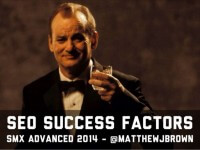 Matthew Brown provided a bit of caution on his old position of “Mark up ALL THE THINGS?”. You may not want all of your result types to show up depending on what stage searchers are in. For example, video snippets showing up when people are ready to buy and don’t want to learn more about a product can kill Click-Through-Rate (CTR). Top reference from MJB’s preso was to AJ Kohn’s post on Knowledge Graph Optimization: Notorious KGO: Mo’ Entities, Mo’ Traffic.
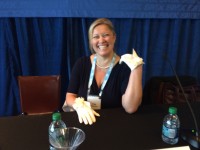 Another SEMpdx Advisory Board member Lisa Williams (check the Joan Holloway style gloves) kicked off this Mad Men themed session, complete with one of my favorite Mad Men quotes:
“If you don’t like what is being said, change the conversation.” — Don Draper
All four presenters provided quality presentations chalk full of good resources. Mike King shared some good social listening tools including IceRocket, Topsy, Social Mention as free options and Radian6, Sprinklr and Sysomos as paid tools in his Social SEO Tactics presentation.
Paid search folks don’t like to share links quite as freely as the SEO and content marketers…imagine that (plus I was a slacker in this presentation and didn’t take notes, sorry). So, just for the fun of it check out Marty’s presentation and try to follow it w/o him screaming at to you…good luck.
A lot of time was spent by this group talking about how to find, remove and/or disavow bad links, as well as some good ideas of where to find new quality links. It was the first mention of “Negative SEO” in the presentations that I attended. Übersuggest was mentioned by Prashant Puri as a good keyword research tool for link building. Link Research Tools and Link Detox got a few mentions as well for people to use to see what negative links they may have and how to start getting them removed.
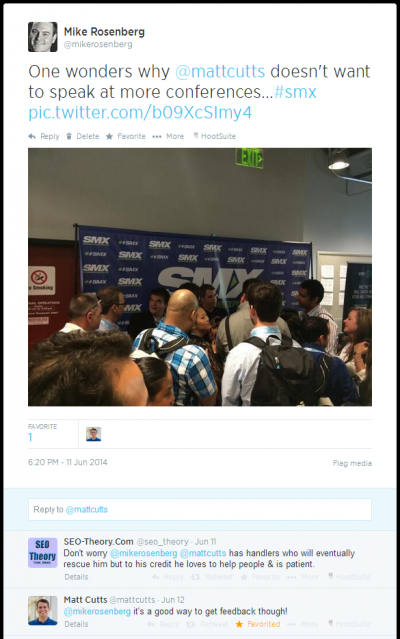 You&A With Matt Cutts
As usual this session featured a few Google announcements and a Q&A hosted by Search Engine Land Editor Danny Sullivan and answered by Google’s webspam killer Matt Cutts. Nothing really groundbreaking this year…Matt uses Google+ still (I think the audience probably makes up about half of G+’s active user base), neither Matt or Danny are particularly skilled at throwing stuffed hummingbirds and Google on an android phone can follow a conversational search string via voice commands.
Actually if you want a nice recap, I was sitting near Sugarrae and she was furiously tweeting and taking notes, so go read her post.
That was the end of day one and Matt got swarmed on his way out…but I guess he doesn’t mind. (more…)